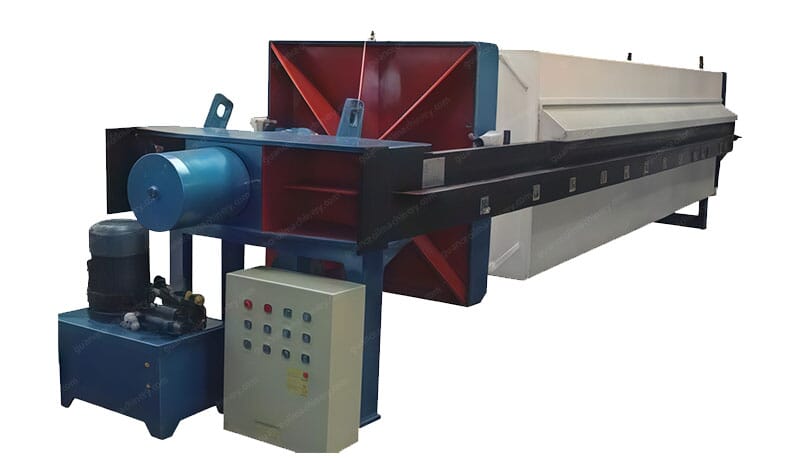
| Model | Compression Method | Filter Plate Type | Filter Plate/Dimension (mm) | Filter Chamber Working Pressure | Filtration Area | Motor Power | |
|---|---|---|---|---|---|---|---|
| GC-350 | Manual/Jack | Plate and Frame Type | 350*350 | ≤0.6MPa | 2-5M² | 1.1-1.5KW | |
| GC-450 | 450*450 | 5-15M² | 1.5-3KW | ||||
| Box type | |||||||
| GC-650 | Jack/Hydraulic | 650*650 | 15-40M² | 2.2-4KW | |||
| GC-800 | Hydraulic | 800*800 | ≤1.0MPa | 30-100M² | 3-11KW | ||
| Diaphragm Filter | GCG-800 | Hydraulic Automatic | |||||
| GCG-1000 | 1000*1000 | ||||||
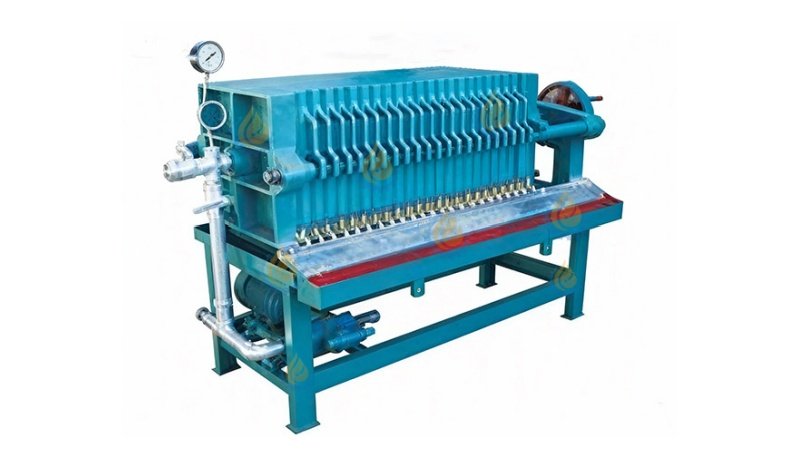
A Plate Oil Filter Machine, commonly known as a plate-and-frame filter press, is widely used in the edible oil processing industry.
To clarify crude oil or refined oil by removing suspended solids, micro‑impurities, and residual moisture.
Placed after screw pressing or prior to packaging, this machine plays a critical role in improving oil clarity, stability, and shelf life.
Why Use a Plate Oil Filter Machine in Oilseed Processing?
When processing oilseeds (such as soybean, sunflower, rapeseed, peanut, etc.), the oil extracted often contains fine seed particles, fiber debris, and moisture.
Without proper filtration, these contaminants can
– Cause cloudiness or sediment in the final oil.
– Accelerate spoilage or rancidity.
– Impair the performance of oil refining plant machine or bottling equipment.
By using a Plate Oil Filter Machine, processors can
1. Enhance Oil Purity & Appearance: The filter press traps solid particles and moisture between filter cloths, yielding a cleaner, more transparent oil.
2. Extend Product Shelf Life: Removing residual moisture and suspended solids reduces the risk of microbial growth and oxidation.
3. Protect Packaging and Handling Systems: Cleaner oil is smoother through filling lines, reducing clogging or wear in valves and pumps.
4. Support Small to Medium-Sized Plants: The plate-and-frame press is especially suited for independent oil mills or semi-continuous oil refinery plant.
How It Works: Operating Principle
The working principle of a Plate Oil Filter Machine is based on pressure filtration combined with a layered plate-and-frame structure:
1. Filter Plate Stack: The machine consists of a series of alternating filter plates and filter frames.
2. Oil Pump Supply: Crude or partially refined oil is pumped into the filter chambers under pressure.
3. Filtration Process: As solids are trapped on the cloth or paper, while the clarified oil passes through to the filtrate outlet.
4. Cake Formation: Once filtration is complete, the machine is depressurized, and the plates are separated to remove the cake.
5. Cloth Replacement / Cleaning: After discharge, filter cloths or papers are replaced or cleaned.
Key Design Features & Technical Specifications
| Feature | Purpose |
|---|---|
| Material Construction | High-grade stainless steel (304 or 316L) is often used for food-grade applications. |
| Filter Plate and Frame Count | More plates or greater filter area or higher throughput. |
| Working Pressure | Determines filtration speed; the frame must withstand the pressurized oil. |
Real‑World Use & Application Scenarios
Edible Oil Mills: Commonly used after screw press or hydraulic pressing to polish crude oil.
Refinery Applications: Used in refining plants to filter bleaching oil or partially refined oil.
Sustainable / Small-Scale Producers: Particularly suitable for community pressing centers or cooperatives that lack access to complex refining infrastructure.
If you’re planning a vegetable oil or animal fat processing line (whether for soybean, sunflower, rapeseed, or other oilseeds), Contact Guance Machinery for a free consultation and equipment quote within 24 h.
Plate Oil Filter Machine Advantages
1. High Filtration Efficiency: Capable of removing very fine particles and moisture, essential for edible oil quality.
2. Modular Capacity: Depending on the model, these machines can be scaled to meet different production volumes.
3. Low Maintenance: With correct operation, cloths can be reused, and plates are reusable.
4. Hygienic Design: 304/316 Stainless steel and food-grade materials support food safety.
5. Cost-Effective for SMEs: Compared to complex oil refining plant machine, a plate filter press has lower capital and operational costs for small to medium oil producers.
Q1: Can the Plate Oil Filter Machine handle very viscous oils or high-solid sludges?
A: It depends. For very viscous oils or slurries with high solid content, you may need a larger number of plates, a more powerful pump, or precursory sedimentation to reduce the load on the filter press.
Q2: How often should filter cloth be replaced?
A: This depends on your oil’s impurity profile. If the crude oil has a lot of fine particles, cloths may clog more quickly.
Q3: Is a fully automatic plate filter press necessary?
A: Not always. For small‑to‑medium plants, a manual or semi‑automatic plate press may provide a good balance between cost, performance, and ease of maintenance.