| Model | Filtration Area (㎡) | Output (T/H) | Filter-Cake Volume (L) | Weight (kg) | |
|---|---|---|---|---|---|
| Edible Oil | Bleaching Clay | ||||
| LF-3 | 3.0 | 0.4-0.6 | 0.2 | 120 | 300 |
| LF-5 | 5.0 | 0.5-1.2 | 0.5 | 250 | 400 |
| LF-10 | 10 | 1.6-3 | 1.5 | 800 | 900 |
| LF-15 | 15 | 3-5 | 2 | 1300 | 1300 |
| LF-20 | 20 | 4-6 | 4 | 1680 | 1700 |
| LF-25 | 25 | 5-7 | 6 | 1900 | 2000 |
| LF-30 | 30 | 6-8 | 7 | 2300 | 2500 |
| LF-35 | 35 | 7-9 | 8 | 2650 | 3000 |
It is designed for the efficient separation of solids (sediments, bleaching earth, catalyst residues, etc.) from liquids (e.g., crude oil, bleached oil, winterized oil, or other process oils).
In the context of edible oil oilseed processing, a Leaf Filter helps you achieve clean filtrate (oil) with minimal suspended solids.
Which is critical for downstream quality (color, clarity, shelf‑life) and for protecting downstream equipment (pumps, heaters, storage).
Filter Structure & Leaf Elements
The core of a Leaf Filter is a set of “leafs” — typically 10–60 leaves stacked inside a pressure vessel.
Each leaf usually consists of five layers of stainless-steel wire mesh (or sometimes carbon-steel mesh).
The mesh is supported by a tubular frame, ensuring mechanical strength and sealing.
Filtration Cycle & "Cake" Formation
1. Filtration: The oil (maybe after decolorization or winterization) containing suspended solids or adsorbents is pumped under pressure into the vessel.
2. Cake Discharge & Cleaning: Once cake builds to a maximum thickness or pressure drop becomes significant, filtration stops.
3. Leaf Washing & Reuse: After cake discharge, leaves are cleaned (e.g., by water jets or back‑flushing) and can be reused for the next cycle.
Types of Leaf Filter — Vertical vs Horizontal
| Type | Typical Use Case | Advantages | Trade‑offs |
|---|---|---|---|
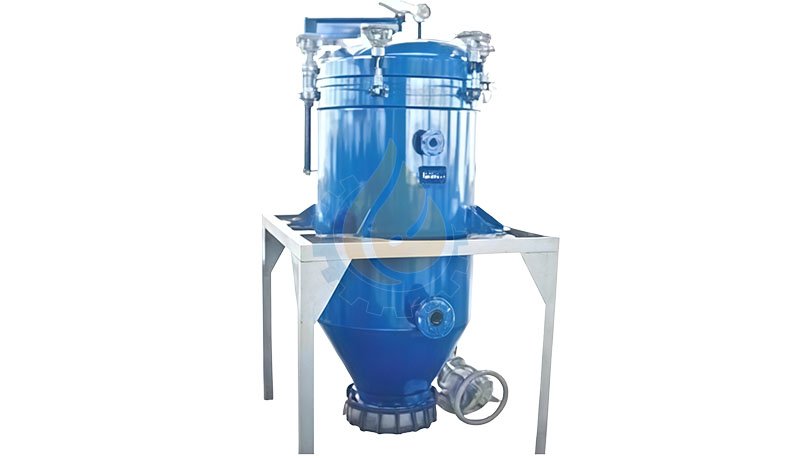
| Vertical Pressure Leaf Filter | Situations where space is limited, smaller throughput | Compact footprint, fully enclosed, safe for flammable or corrosive liquids | Smaller filtration area → lower throughput per batch |
| Horizontal Pressure Leaf Filter | Medium to large-scale edible‑oil refining, bleaching, winterization | Large filtration area → high throughput, efficient cake discharge, easy inspection & maintenance | Larger footprint, heavier vessel |
Typical Use Cases in Oilseed / Edible Oil Processing
Leaf Filters are commonly employed at several stages
Crude oil filtration: Immediately after oil extraction (screw press or solvent extraction) to remove residual seed particles, gums, or dust.
Post‑bleaching filtration: After bleaching with earth or adsorbents, to separate spent bleaching earth from bleached oil.
Winterization dewaxing filtration: To remove waxes or precipitates after cooling-crystallization, before final oil polishing.
If you tell me your target daily capacity (e.g., tons/day), seed type (e.g., soybean, canola), and whether you’re using vertical leaf filter or horizontal leaf filter.
Contact Guance Machinery can recommend specific Leaf Filter models.
Why Leaf Filter Matters in Oilseed / Edible Oil Processing
1. High filtration efficiency: Because of the large surface area and multi-layer mesh, Leaf Filters can effectively remove fine particles, bleaching earth etc.
2. Improved oil quality and clarity: Solutions for various plant oils (e.g. palm, sunflower, soybean), clarify after bleaching or winterization helps meet product standards for color, turbidity, and storage stability.
3. Adaptable to different processes: Whether crude oil filtration, post-bleaching filtration, winterization, or catalyst removal, Leaf Filter all are competent.
4. Lower maintenance & long lifespan: Stainless-steel mesh leaves, when properly maintained, last for years.
Q1: How do I choose the right Leaf Filter?
A: Check capacity, pressure rating, mesh type, discharge method, and your oil process needs, or contact Guance Machinery.
Q2: Where is a Leaf Filter used?
A: It is used in edible oil refining, oilseed processing, and other liquid-solid separation steps.
Q3: What materials are Leaf Filters made of?
A: They are mainly made from carbon steel or stainless steel 304 or 316.