| Model | Screen Width (cm) | Capacity (wheat) (t/h) | Suction Volume (m³/h) | Weight (kg) | Dimensions (L×W×H mm) |
|---|---|---|---|---|---|
| ODM43 | 43 | 1-1.5 | 3000 | 215 | 1270×700×1600 |
| ODM50 | 50 | 2-4 | 4000 | 230 | 1420×780×1800 |
| ODM60 | 60 | 3-5 | 4500 | 280 | 1450×876×1800 |
| ODM80 | 80 | 5-7 | 6000 | 340 | 1450×1046×1800 |
| ODM100 | 100 | 7-9 | 8000 | 400 | 1500×1246×1900 |
| ODM125 | 125 | 9-11 | 10200 | 500 | 1470×1496×1900 |
| ODM125 | 125 | 15-18 | 12000 | 650 | 1649×1714×2083 |
| ODM150 | 150 | 11-14 | 12000 | 600 | 1580×1746×1900 |
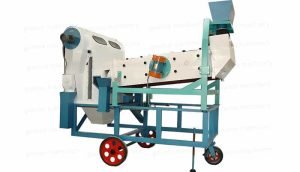
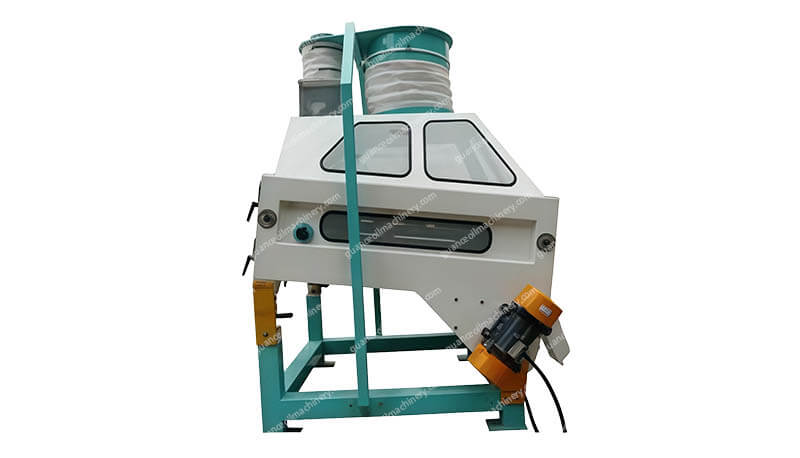
Oilseed destoner machine are core equipment in the pre-processing of oils. Through the combined action of a vibrating screen and airflow, they separate impurities such as stones and mud from oilseeds based on differences in specific gravity.
The process encompasses four stages: feeding and homogenizing, layered screening, impurity separation, and clean seed discharge.
It effectively protects subsequent oil pressing or solvent extraction equipment, improves oil yield and product purity, and is a crucial step in ensuring the continuity and quality of oilseed processing.
Why Use a Destoner in Oilseed Processing?
1. Protect Downstream Equipment: Oilseeds mixed with stones or dense debris can cause excessive wear or damage to oil‑pressing machines, flaking mills, and other downstream gear.
2. Improve Oil Quality & Yield: Heavy impurities not only reduce the effective seed mass but can also contaminate oil or meal.
3. Increase Safety: Many destoners operate under negative pressure or with enclosed air‑flow systems, limiting dust and improving factory hygiene.
Working Principle: How the Oilseed Destoner Machine Works
1. Feeding & Vibration: Oilseeds (plus any stones) enter the destoner hopper and are distributed onto a vibrating deck (sieve) composed of two or more screen layers.
2. Stratification: As the deck vibrates, materials stratify: lighter particles (oilseeds) tend to float, while heavier ones (stones) sink.
3. Airflow Separation
– In a suction-type destoner, a negative airflow moves through the bed, lifting lighter seeds upward, while heavier stones drop to the bottom and are discharged.
– In a pressure-type destoner, pressurized air from below pushes upward; lighter material rises, and heavy impurities remain on or fall through the deck.
4. Discharge
– Cleaned seeds exit via the designated “light‑fraction” outlet.
– Stones and other dense particles are removed via a dedicated heavier discharge channel.
Key Design Features & Technical Specifications
Here are important technical points and typical design features for an oilseed destoner:
| Feature | Description |
|---|---|
| Dual vibrators | Provide balanced, stable oscillation of the sieve, improving separation efficiency. |
| Adjustable air‑gate | A control mechanism (e.g., a calibrated damper) allows the operator to precisely regulate airflow, which is critical to matching different seed densities. |
| Suction or blower system | Depending on model, machines use suction (negative pressure) or blower (positive pressure) as their air source. |
| Inspection windows | Transparent or removable windows help operators monitor the internal flow and material behavior. |
| Screen inclination | The slope of the vibrating deck can be adjusted (often between ~5°–9° or more) to accommodate different oilseeds and improve stratification. |
| Low‑dust design | Well-sealed chassis, air‑return systems, and aspiration may be included to prevent dust leakage. |
| Robust frame & springs | Rubber springs or other vibrating supports help isolate vibrations and extend longevity. |
Contact Guance Machinery for a free consultation and equipment quote within 24 h.
Oilseed Destoner Machine Advantages
1. Oilseed Destoner Machine: The is used to efficiently remove stones and impurities from oilseeds, ensuring cleaner raw materials.
2. Improved Oil Quality: By removing foreign materials, it enhances oil quality, reducing contamination and improving the purity of the final product.
3. Increased Processing Efficiency: The device increases processing efficiency by minimizing damage to equipment and improving the consistency of the oil extraction process.
Q1: What types of oilseeds can be processed with this equipment?
A: It is suitable for various oilseeds solutions, including soybeans, sunflower seeds, and canola, among others.
Q2: Is the equipment easy to maintain?
A: Yes, it is designed for easy maintenance with minimal downtime, requiring simple cleaning and part replacements when necessary.
Q3: Is the oilseed destoner machine suitable for small-scale production?
A: While ideal for semi-continuous oil refinery plant, it can also be used in smaller operations, depending on the processing capacity required.