Small-scale batch oil refining plays a critical role in producing high-quality edible oil. To achieve stable results, operators must clearly understand each processing step and control key parameters carefully. Therefore, the entire process requires both technical knowledge and practical experience.
Processing step
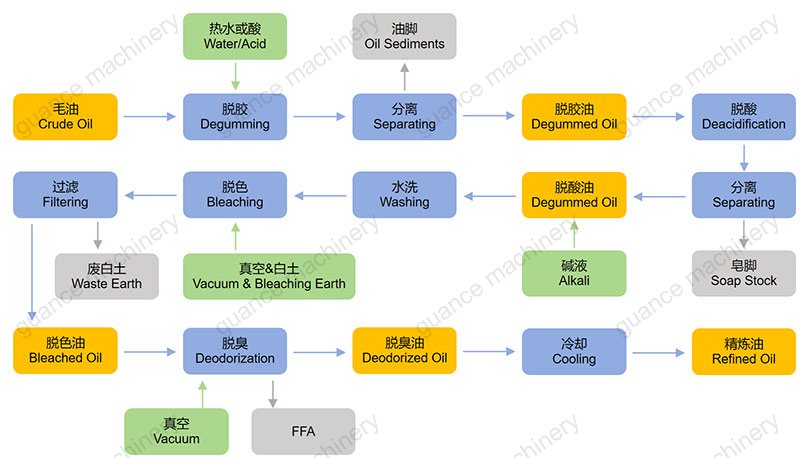 Flow-Process
Degumming
First, the process begins with degumming. During this stage, operators heat crude oil and add water or acid to remove phospholipids and impurities. Meanwhile, proper mixing improves reaction efficiency. As a result, gums separate more effectively from the oil. Moreover, temperature control remains very important because excessive heat may damage oil quality.
Neutralization
Next, neutralization removes free fatty acids. Operators add an alkaline solution into the oil and start a chemical reaction. Consequently, soapstock forms and separates from the oil. In addition, stirring speed directly affects reaction uniformity. Therefore, operators must monitor mixing conditions carefully to avoid incomplete neutralization.
Bleaching
After that, bleaching improves oil color and removes pigments. Operators mix bleaching earth or activated carbon with oil under vacuum conditions. Meanwhile, continuous stirring ensures full contact between oil and adsorbent. Furthermore, filtration follows the bleaching stage to remove spent materials. As a result, oil color becomes lighter and more stable.
Deodorization
Then, deodorization removes odor compounds and volatile substances. Operators heat the oil under high vacuum and inject steam. Consequently, unwanted smells are stripped out efficiently. However, temperature control is extremely sensitive in this step. If temperature rises too high, oil quality may decline. Therefore, careful monitoring is necessary throughout the process.
Parameter
In addition, each oil type behaves differently during refining. For example, soybean oil contains higher phospholipid content, so degumming becomes more important. Meanwhile, peanut oil requires milder treatment because it contains fewer impurities. On the other hand, sunflower oil often needs stronger bleaching to achieve a clear color. Therefore, operators must adjust parameters based on raw material characteristics.
Quality control
Moreover, quality control plays a central role in the whole process. Operators regularly test acidity, color, and odor at each stage. As a result, they can quickly detect issues and make adjustments. Furthermore, consistent monitoring helps maintain stable final product quality.
Process optimization
Finally, process optimization improves both efficiency and output quality. For instance, adjusting temperature curves, reaction time, and vacuum level can significantly improve results. In addition, proper equipment maintenance ensures stable operation and reduces downtime.
Conclusion
In conclusion, small-scale batch oil refining requires strict control of each step. By understanding the process flow and key control points, producers can achieve high-quality edible oil with stable performance. Therefore, careful operation and continuous optimization are essential for long-term success.
📩 Get Your Free Quote Today
Contact us today to discuss your project, capacity requirements, and target materials. Our team will reply within 24 hours with a customized proposal. You can also reach us directly at guanceoilmachinery@gmail.com — we are here to help!