Soybean oil is one of the most widely produced vegetable oils in the world. With increasing demand from the food, feed, and industrial sectors, many investors are looking for efficient soybean oil processing solutions that can maximize production capacity and product value.
A complete soybean oil processing plant includes several interconnected sections, starting from soybean preparation and continuing through oil extraction, meal processing, solvent recovery, and oil refining. Therefore, successful plant design requires not only individual equipment selection but also complete process integration.
A well-designed soybean oil production line helps processors achieve higher oil recovery, better product quality, lower operating costs, and stable long-term operation.
Overview of Soybean Oil Processing Flow
A modern soybean oil processing plant usually includes the following main sections:
1.Soybean preparation
2.Oil extraction
3.Solvent recovery and meal processing
4.Crude oil treatment
5.Oil refining
Each section performs an essential function. Moreover, the performance of one section directly affects the efficiency of the entire plant.
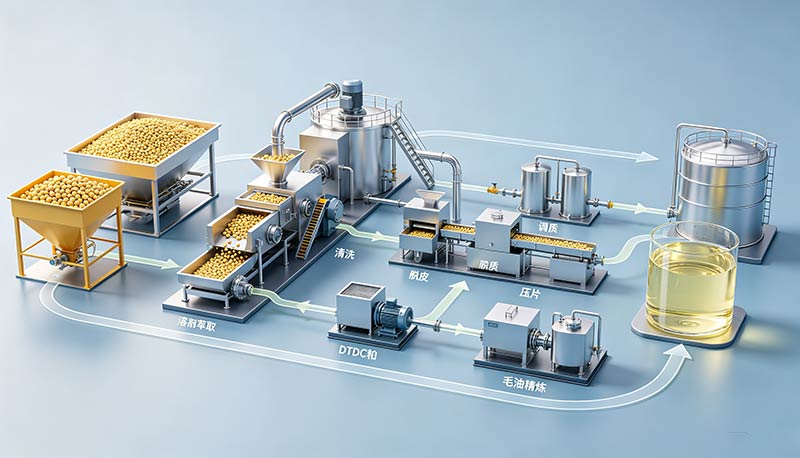
The typical process flow is:
Soybean Receiving
→ Cleaning
→ Cracking and Dehulling
→ Conditioning
→ Flaking
→ Solvent Extraction
→ DTDC Processing
→ Crude Oil Refining
→ Finished Soybean Oil
 production-flow
Soybean Preparation Section
The first stage of soybean processing is preparation.
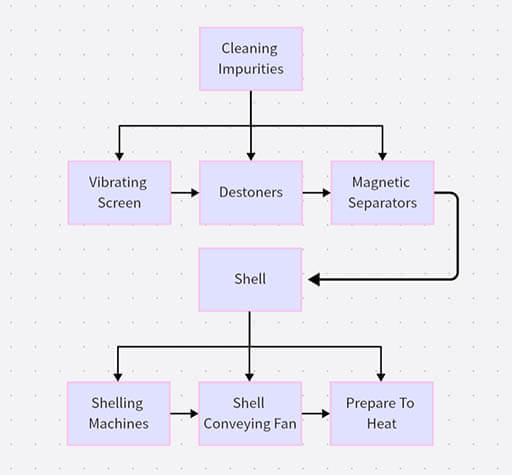
Fresh soybeans usually contain impurities such as stones, dust, metal particles, and plant residues. Therefore, cleaning equipment is installed to remove these materials before further processing. After cleaning, soybeans enter the cracking section. Cracking rollers break the beans into smaller pieces, which helps separate the hulls from the kernels. Next, the dehulling process removes soybean hulls. This step improves the quality of soybean meal and increases processing efficiency. Furthermore, removing excess fiber helps reduce energy consumption in downstream operations. Afterward, the soybean kernels enter conditioning equipment. Steam and heat are applied to adjust moisture and temperature. As a result, the material becomes suitable for flaking. Finally, flaking rollers compress the conditioned soybeans into thin flakes. Thin flakes provide a larger surface area, allowing solvent to penetrate more effectively during extraction.
Soybean Oil Extraction Section
After preparation, soybean flakes enter the extraction section.
For large commercial soybean plants, direct solvent extraction is the most common technology. Unlike mechanical pressing, solvent extraction can recover a higher percentage of oil from soybean flakes. Inside the extractor, solvent contacts the soybean flakes and dissolves the oil. Consequently, the oil separates from the solid material and forms miscella. Meanwhile, the extracted soybean meal moves to the DTDC system for further treatment. The solvent extraction process offers several advantages: Higher oil recovery, Lower residual oil in meal, Continuous operation, Suitable for large production capacity. Therefore, most industrial soybean processing plants choose solvent extraction when production capacity reaches a commercial scale.
DTDC and Soybean Meal Processing
After leaving the extractor, soybean meal still contains residual solvent. Therefore, it must be treated before becoming a finished feed product.
The DTDC system performs four important functions: (1) Desolventizing (2) Toasting (3) Drying (4) Cooling.
During desolventizing, steam and heat remove residual solvent from the meal. At the same time, solvent vapor is recovered and reused in the extraction system. Next, the toasting section improves soybean meal quality by reducing anti-nutritional factors and enhancing protein digestibility. Furthermore, drying controls the moisture content, while cooling prepares the meal for storage and transportation. As a result, the plant produces high-quality soybean meal with excellent commercial value.
Crude Soybean Oil Refining Section
After extraction, crude soybean oil still contains impurities that must be removed before edible use. Therefore, the crude oil enters the refining section.
A complete soybean oil refinery usually includes:
1. Degumming
Degumming removes phospholipids and improves oil stability.
2. Neutralization
In chemical refining systems, alkaline treatment reduces free fatty acids and removes additional impurities.
3. Bleaching
Activated clay removes pigments, oxidation products, and trace impurities, resulting in clearer oil.
4. Deodorization
High temperature, vacuum, and steam stripping remove unwanted odors and volatile compounds.
Consequently, refined soybean oil achieves improved appearance, taste, stability, and shelf life.
Chemical Refining and Physical Refining Options
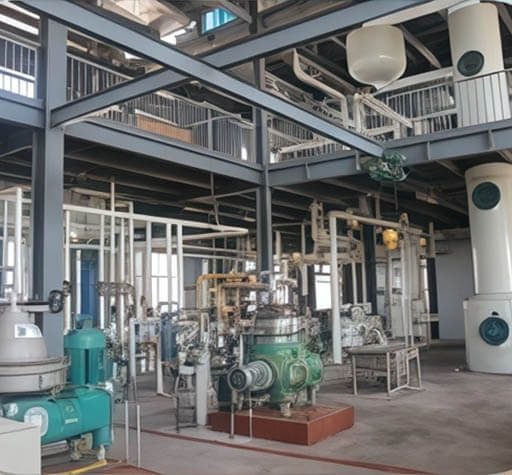
Depending on crude oil quality and production requirements, soybean oil plants can use different refining technologies. Chemical refining is widely used because it provides flexible impurity removal performance. However, physical refining has become increasingly popular in large plants because it reduces chemical consumption and can lower refining losses.
Therefore, selecting the right refining method requires evaluation of: (1) Raw soybean quality (2) Free fatty acid content (3) Production capacity (4) Final product requirements (5) Local regulations
A professional engineering team can help determine the most suitable solution.
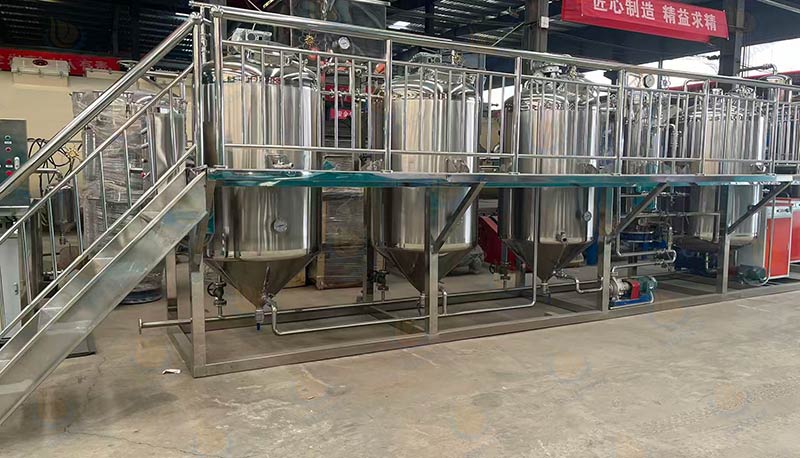 refining-equipment
Equipment Selection for Different Plant Sizes
Soybean oil processing plants vary greatly in capacity.
Small plants may focus on mechanical pressing because of lower investment requirements and simpler operation. However, medium and large plants usually require integrated systems including preparation, solvent extraction, DTDC, and refining.
For example:
Small plants: soybean pressing lines
Medium plants: pressing or extraction solutions depending on investment goals
Large plants: complete solvent extraction and refining plants
Consequently, plant design should always match production targets and business objectives.
Importance of Complete Plant Engineering
Building a soybean oil processing plant involves much more than purchasing individual machines.
A successful project requires: (1) Process design (2) Equipment selection (3) Plant layout (4) Utility calculation (5) Installation guidance (6) Commissioning support
Furthermore, different regions may have different requirements for electricity, steam supply, environmental protection, and product standards.
Therefore, experienced engineering support is essential for achieving reliable plant operation.
Value of Soybean By-products
A complete soybean processing plant produces not only oil but also valuable by-products.
Soybean meal is widely used in animal feed due to its high protein content. In addition, soybean hulls can also be utilized as animal feed ingredients or biomass materials. Consequently, efficient by-product utilization improves the overall profitability of the project.
Conclusion
A complete soybean oil processing plant integrates multiple technologies, including soybean preparation, solvent extraction, meal processing, solvent recovery, and oil refining.
Each section plays an important role in achieving high efficiency and stable production. Therefore, investors should consider the entire production system rather than individual equipment when planning a soybean oil project.
With proper process design and reliable equipment, a soybean oil processing plant can provide long-term economic benefits by producing high-quality soybean oil and valuable soybean meal.
From small processing facilities to large industrial oil mills, a well-designed turnkey solution helps processors transform soybeans into profitable products efficiently and sustainably.
📩 Get Your Free Quote Today
Contact us today to discuss your project, capacity requirements, and target materials. Our team will reply within 24 hours with a customized proposal. You can also reach us directly at guanceoilmachinery@gmail.com — we are here to help!