Oil Cakes Solvent Extraction
Oil Cakes Solvent Extraction is a widely used method to recover vegetable oils from pressed or prepressed oil cakes (such as soybean, peanut, rapeseed, sunflower, cottonseed, palm kernel, etc.) or low-oil content seeds (like soybean, rice bran) after flaking.
Guance Machinery process uses a hydrocarbon solvent extraction (commonly No. 6 solvent oil — e.g. n-hexane) to dissolve residual oil in the cake, enabling much higher oil yield and leaving the de-oiled meal with a residual oil content typically below 1%.
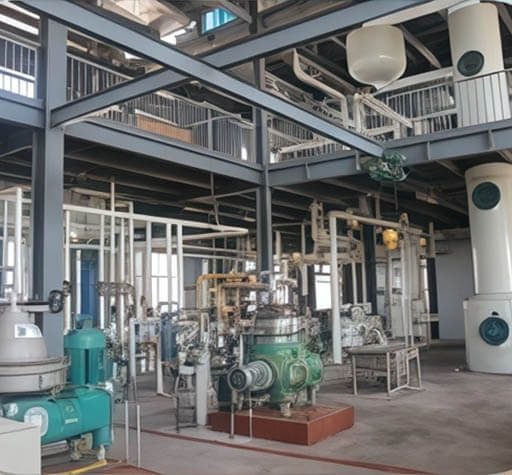
A complete solvent extraction line — such as those offered by Guance Machinery — integrates multiple core units (Rotocel Extractor, Desolventizer-Toaster, Evaporator, Stripping Tower, Condenser, Absorption Tower, Crude Oil Tank) to deliver high extraction efficiency, energy savings, and solvent recovery.

Key Process Steps & Major Equipment
1. Extraction (Leaching) — Rotocel Extractor
The prepared oil cakes or flakes are fed into a continuous rotary extractor (like a Rotocel type), where solvent is sprayed to wash out oil by percolation/immersion.
The solvent dissolves the oil, forming a miscella (oil + solvent), while leaving behind wet meal.
This continuous counter-current leaching design ensures effective solvent contact, stable operation with low power consumption, and yields low residual oil in meal.
2. Wet Meal Solvent Removal — Desolventizer / Toaster / Dryer / Cooler
The wet meal discharged from the extractor still contains solvent.
In the Desolventizer-Toaster-Dryer-Cooler unit (DTDC), the meal undergoes indirect steam heating, direct steam toasting, hot-air drying and cold-air cooling.
This removes residual solvent and moisture, and conditions the meal — often yielding de-oiled meal suitable for feed, with residual oil ≤ 1%.
Beyond safety and solvent removal, this stage can also inactivate anti-nutritional factors and stabilize meal quality when meal is intended for feed use.
3. Miscella Separation & Evaporation — Evaporator(s) + Stripping Tower
The miscella is first filtered to remove meal fines, then sent to a multi-stage evaporation system to remove most of the solvent, typically under vacuum to lower boiling point and protect oil quality.
A first-stage evaporator concentrates oil content, followed by a second-stage evaporator.
Afterwards, the concentrated miscella enters a stripping tower (oil stripper) where residual solvent is removed via steam stripping under vacuum, yielding crude extracted oil.
4. Solvent Recovery — Condenser, Absorption Tower, Recycling
Vapors from extraction, desolventizing, evaporation and stripping are routed through condensers and absorption towers.
Condensed solvent is collected, separated from water, and recycled back into the system.
Non-condensable gases are treated (e.g., by absorption) before venting.
This closed-loop design maximizes solvent recovery (often > 98%) and minimizes losses — key for both economic and environmental performance.
5. Crude Oil Storage — Crude Oil Tank
Finally, the stripped crude oil is collected into crude oil tanks, ready either for storage or to be sent to downstream oil refining plant (degumming, neutralization, bleaching, deodorization) when edible oil is the final goal.

Guance Machinery’s full plant design typically includes crude oil storage as part of a turnkey solution.
Why This Process Matters
High Oil Recovery: Compared with mechanical pressing alone, solvent extraction recovers much more oil — pushing residual oil in meal down to ≤ 1%.
Versatility: The Guance Machinery’s line can handle a wide range of raw materials — from low-oil seeds to pre-pressed cakes of high-oil seeds.
Energy & Solvent Efficiency: Through heat integration (e.g. using steam from desolventizer to feed evaporators) and closed-loop solvent recycling, the process conserves energy and reduces solvent consumption.
Quality & Safety: Operating under vacuum, and using controlled desolventizing, ensures the crude oil has low residual solvent, and de-oiled meal is safe — suitable for animal feed or other uses.
Typical Performance Indicators (for a well-designed plant)
| Parameter | Typical Value / Range |
|---|---|
| Residual oil in meal after extraction | ≤ 1% |
| Solvent consumption (new solvent per ton raw material) | ~ 1.5–2 kg/t (No. 6 solvent) |
| Steam consumption | ~ 200–300 kg/t raw material (varies with plant scale) |
| Solvent recovery efficiency | > 98% (closed-loop condensation and absorption) |
| *Actual values depend on raw material type, plant capacity and operating conditions. | |
Integration with Guance Machinery’s Solution
Guance Machinery offers turnkey solvent-extraction plants covering the full workflow: from raw material preparation (prepressed cake or flakes) through extraction, desolventizing, evaporation/stripping, solvent recovery and crude oil storage.
Our equipment support a broad range of oilseeds — including soybean, canola/rapeseed, sunflower, peanut, cottonseed, palm kernel and rice bran — giving flexibility to client depending on local raw material availability.
If you like, I can also provide a free quote for oil cakes solvent extraction, based on recent projects — please contact Guance Machinery.
📩 Get Your Free Quote Today
Contact us today to discuss your project, capacity requirements, and target materials. Our team will reply within 24 hours with a customized proposal. You can also reach us directly at guanceoilmachinery@gmail.com — we are here to help!